
Bad Windsheim - Bavaria, Germany

Updated: Oct 25, 2025
Franconia. Bavaria. Bayern. All these names conjure images of Oktoberfest - steins swelling with local, limitless bier and sightings of liederhosen. This region is what many visitors think of when they imagine Germany.
But as much as I love these festivities, my association with a place, whether it be a new city or country, is dependent on its landscape. Most people can list the names of streets, highways, and restaurants after they’ve lived in a locale long enough. For me, it’s the rivers, valleys, creeks, and peaks that define a place.

Evenings are spent tracing topographical maps with my fingers. Rock and water. Trails and routes unfold in my mind’s eye, building the makings of future backpacking trips and adventures in the outdoors. Ask me about the city, and I’ll speak to you about the trees. I’ll talk your ear off about the seasons or the quiet riverbank perfect for a golden-hour picnic in the spring.
You know about the hot newly-opened restaurant off Texas Avenue. But have you seen the desert bloom? Have you watched the reflection of white sand dunes in the transient, pooled water after a monsoon rain, the sky mirroring the ground in crystal clarity?

But back to Germany and my time here - seven months. Seven months of long hours in an indoor setting. At least the building had windows. And a view of a nearby Norway spruce with its heavy green branches weighed down, saluting the ground, after hard summer rains. The occasional stroll though the countryside was my reprieve from the job. Bavaria was my quiet escape.
The first time I watched the Bavarian countryside through a car window, I half expected Steve McQueen from The Great Escape to shoot over a nearby hill on his legendary motorcycle. That famous chase scene, ending in his character’s demise, was my only visual comparison for the fields and orchards scrolling by in the distance.

When I think of Bavaria now, I imagine interwoven crop fields spread like an evolving collage over soft, rounded hills. The hill-tops are lined by sycamore maple, linden, and oak. Mist sits heavy and sullen on the grass on quiet winter mornings. And the sun rises like a distant flame through the fog, shining a tender warm light over the land. Spring paints the view yellow with vibrant and blooming rapeseed. Fields of gold everywhere. Summer brings the lucky hiker a basketful of blackberries. Fall ushers in the arrival of apples, so abundant on the trees that many fall to the ground unpicked.
Here is a subtle beauty. The land doesn't strike the hiker as dramatic or majestic. There are no towering mountains or plunging waterfalls that invoke awe. But in that subtlety lies a peacefulness often found in bucolic settings. Time seems to slow. And specifically around Bad Windsheim, the trails offer the traveler or hiker miles of quiet wanderings.

The BW1 trail is a 8.6 mile loop which I extended by starting from the local train station. I covered a total of 12 miles on average when I hiked this route. From the station, you walk into the tree-lined avenues of Kur Park. A water fountain surrounded by bathing ducks passes on your left. From the park, you begin the loop and meander through an arbor of trees. The fields stretch out to the left and right with the occasional tractor droning along in the distance.
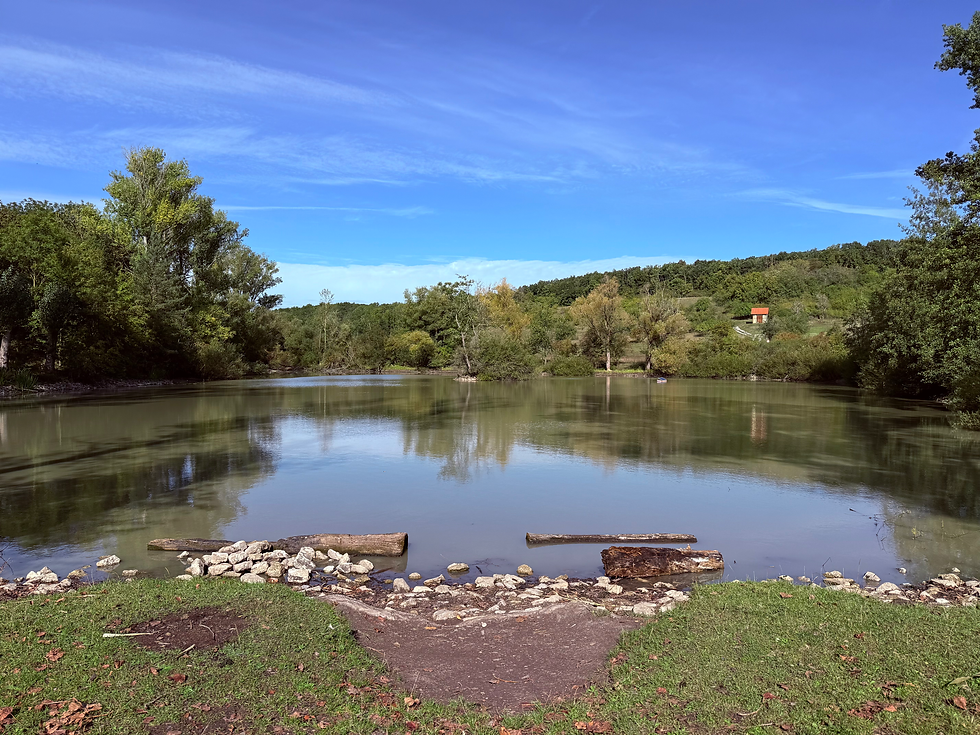
A small pond offers a waterside reprieve for reading and an afternoon snack of apple strudel. Continuing on in the hike, I pass a herd of sheep. Some have bells dangling around their necks. They graze softly on the grass, bells ringing back to me in the wind. A shepherd dog receives a cue from a distant owner and ushers the sheep further into a neighboring field.
The village of Oberntief gradually moves into view. I descend a hilltop and walk into the center of town - a small community of homes, a gasthaus, and a local church, Saint Marien, towering above everything with its stone steeple. I consider stopping for food, but I've got miles to cover. And dinner in Bad Wisheim, perhaps at the Goldener Adler, is a tempting dinner option. The fields continue to scroll by. Blue skies rise overhead, peppered with the occasional cumulus cloud.
The trail breaks hard to the right and makes a rapid ascent through a tunnel of trees. Rounding the top of the hill, I'm met by a vast view of fields in every direction. To my left stands the ruins of Burg Tief - a medieval castle that once occupied this strategic high point. It was eventually destroyed on July 25, 1449 during the First Margrave War. Hundreds of years later only the structural suggestion of what were once moats remain.
The magic of the Burg Tief ruins is rooted in its apple trees. At the cusp of fall, the branches hang heavy and encumbered with fruit. The acrid smell of rotting apples, scattered along the ground and half-eaten by local wild hedgehogs, mixes with the crisp breeze. Across one of the moats, an ancient little linden tree stands tall. It's old. How old I'm unsure. How many years has this great being witnessed?

With the apple orchard behind me, I stroll back into Bad Windsheim through Kur Park. It's a calm walk with the occasional view of grazing cows, staring sheep, and honking geese. This is a hike that I will repeat several times during my stay in Bavaria, each time finding another natural detail to savor.
-Happy Trails
07 OCT 2025


Comments